
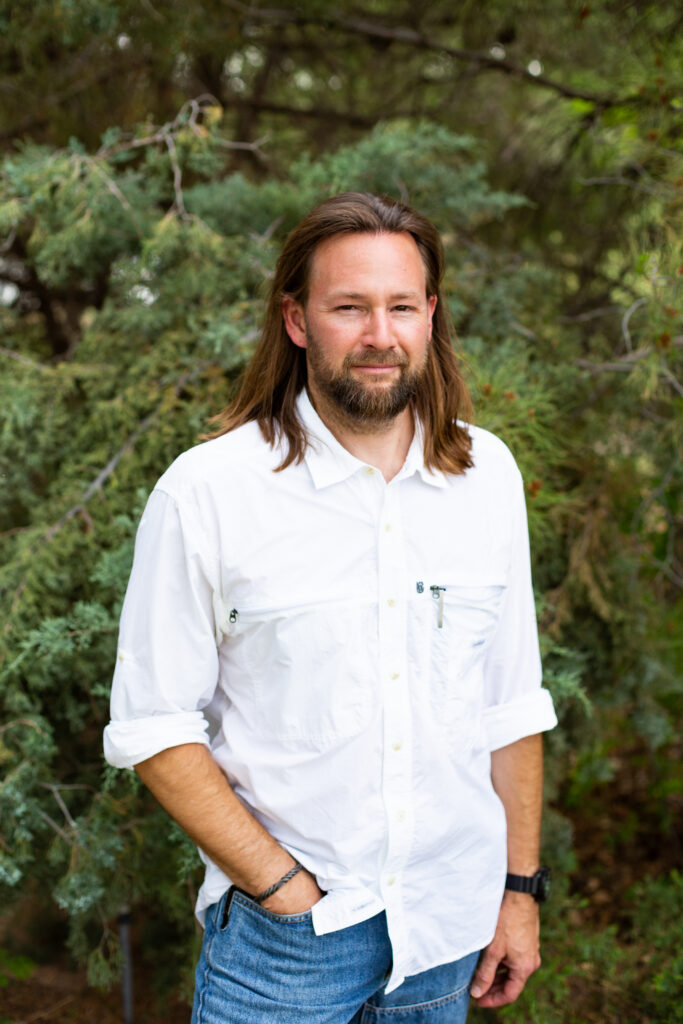
Kurt Caswell is the author of five books of nonfiction, most recently, Iceland Summer: Travels Along the Ring Road (2024), illustrated by Julia Oldham. His other books are Laika’s Window: The Legacy of a Soviet Space Dog (2018), which tells the story of the first animal to orbit the Earth; Getting to Grey Owl: Journeys on Four Continents (2015); In the Sun’s House: My Year Teaching on the Navajo Reservation (2009); and An Inside Passage (2009), which won the 2008 River Teeth Literary Nonfiction Book Prize, and a Texas Tech University President’s Book Award. Caswell was born in Fairbanks, Alaska, and grew up in the Cascade Range in Oregon.
He has worked as a teacher in Hokkaido, Japan, on the Navajo Reservation, at schools in Arizona, California, and Wyoming, and in the MFA program at Vermont College of Fine Arts. A graduate of both the Bread Loaf School of English at Middlebury College (MA), and the Bennington College Writing Seminars (MFA), his work has earned numerous Pushcart nominations, the Lucy Grealy Memorial Scholarship, fellowships at Fishtrap writers’ conference and the MacDowell Colony, and other honors. He is co-editor with James Perrin Warren of Going to See: 30 Writers on Nature, Inspiration, and the World of Barry Lopez, and his essays, stories and reviews have appeared in Fourth Genre, Los Angeles Review of Books, Ninth Letter, North American Review, Orion, Prairie Schooner, Terrain.org, and other publications. He is professor in the Honors College at Texas Tech University, where he teaches writing, literature, and an intensive study abroad course walking the Camino de Santiago in Spain.
Panhandle Creek Press in honored to publish Caswell’s book of poetry, After Hiroshige, due for release May 25th, 2027.
Description:
In 1832, the Japanese woodblock print maker Utagawa Hiroshige (1797-1858) traveled the Tokaido from Tokyo to Kyoto, then one of the busiest roads in the world. He lived during the final decades of the Edo Period (1600-1868), in which the ruling Tokugawa Shogunate maintained peace and prosperity, and also enforced isolation from the rest of the world. Hiroshige chronicled his journey in a series of prints, “The Fifty-three Stations of the Tokaido.” The Japan of Hiroshige’s prints no longer exists and in fact, it vanished almost overnight when Commodore Perry sailed into Tokyo Bay and forced Japan to open trade to the US and the rest of the world.
After Hiroshige is a cycle of poems responding to Hiroshige’s prints. The poems are inspired by the simplicity and acuity of Japanese poetic forms, and so are anchored in the natural world, and often evoke an event or mood. Because Hiroshige’s prints wander away from historical and geographical accuracy, some critics have written that he has given us a second Tokaido. This book offers a third, as the poems not only detail Hiroshige’s prints, but also imagine what the artist thought and felt about cultural nuances and historical events, about the physical and emotional joys and challenges of the road, and about his aspirations as an artist.
Links
Facebook: Kurt Caswell
Instagram: kurtacaswell